

Levi's: A Corporate Algorithm Case Study
Inside Levi Strauss & Co.’s journey from manual forecasting to algorithm-driven growth


Applying AI and algorithms within traditional industries may initially appear challenging—but when done effectively, the benefits can be substantial. We’ve explored numerous cases where established industries embrace algorithm-driven transformations to achieve tangible and practical financial outcomes. To illustrate this potential, we begin our series by examining Levi Strauss & Co.'s successful digital transformation journey. To make case studies like this digestible, we’ve condensed comprehensive reviews and research into two easy-to-reference cards highlighting key facts and outcomes. You can access a downloadable, high-resolution copy here.
Levi's AI Journey: A Timeline
2018 – Starting
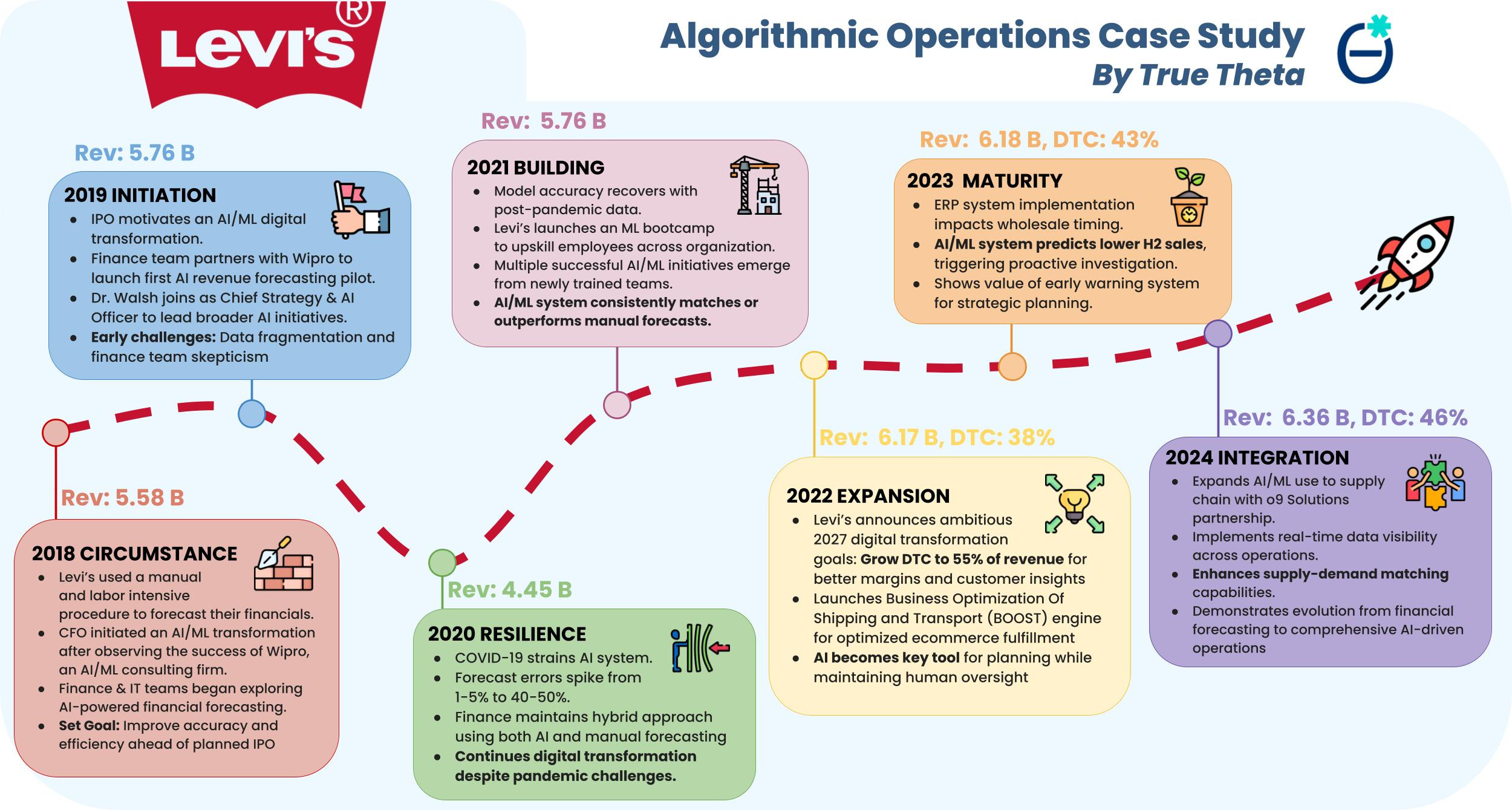
Levi’s relied heavily on manual, labor-intensive financial forecasting methods. With their IPO on the horizon, the finance and IT teams saw how firms like Wipro were nailing AI transformations and decided to jump in. As shown in the timeline graphic, this was the starting point of their journey.
2019 – Initiation
Motivated by their IPO, Levi’s officially initiated their AI/ML digital transformation. They partnered with Wipro for a revenue forecasting pilot and brought in Dr. Walsh as Chief Strategy & AI Officer to lead the charge. Early hurdles? Fragmented data and skeptical finance folks—but they were just getting started.
2020 – Resilience Through COVID
The pandemic strained Levi’s newly established AI systems, temporarily spiking forecast errors. Levi's maintained a hybrid approach, leveraging both AI and manual forecasting to navigate volatility.
2021 – Building & Expansion
Post-pandemic data helped restore model accuracy. Levi’s launched an internal ML bootcamp to upskill staff, generating multiple successful AI-driven initiatives. By this time, the AI/ML systems consistently matched or exceeded the accuracy of manual forecasts.
2022 – Strategic Ambitions & Expansion
Levi’s set ambitious digital goals to achieve 55% Direct-to-Consumer (DTC) revenue share by 2027. They introduced the Business Optimization of Shipping and Transport (BOOST) engine, leveraging AI to streamline e-commerce fulfillment by optimizing shipping routes and reducing delivery times.
2023 – Maturity & Real-Time Adjustments
ERP system integration allowed AI to proactively detect potential sales declines, demonstrating significant strategic value.
2024 – Integration & Enhanced Visibility
Partnered with o9 Solutions to gain real-time supply chain visibility, enabling faster adjustments to demand shifts. Achieved enhanced capabilities in supply-demand matching, transitioning fully from financial forecasting to comprehensive AI-driven operational planning.
Key Outcomes
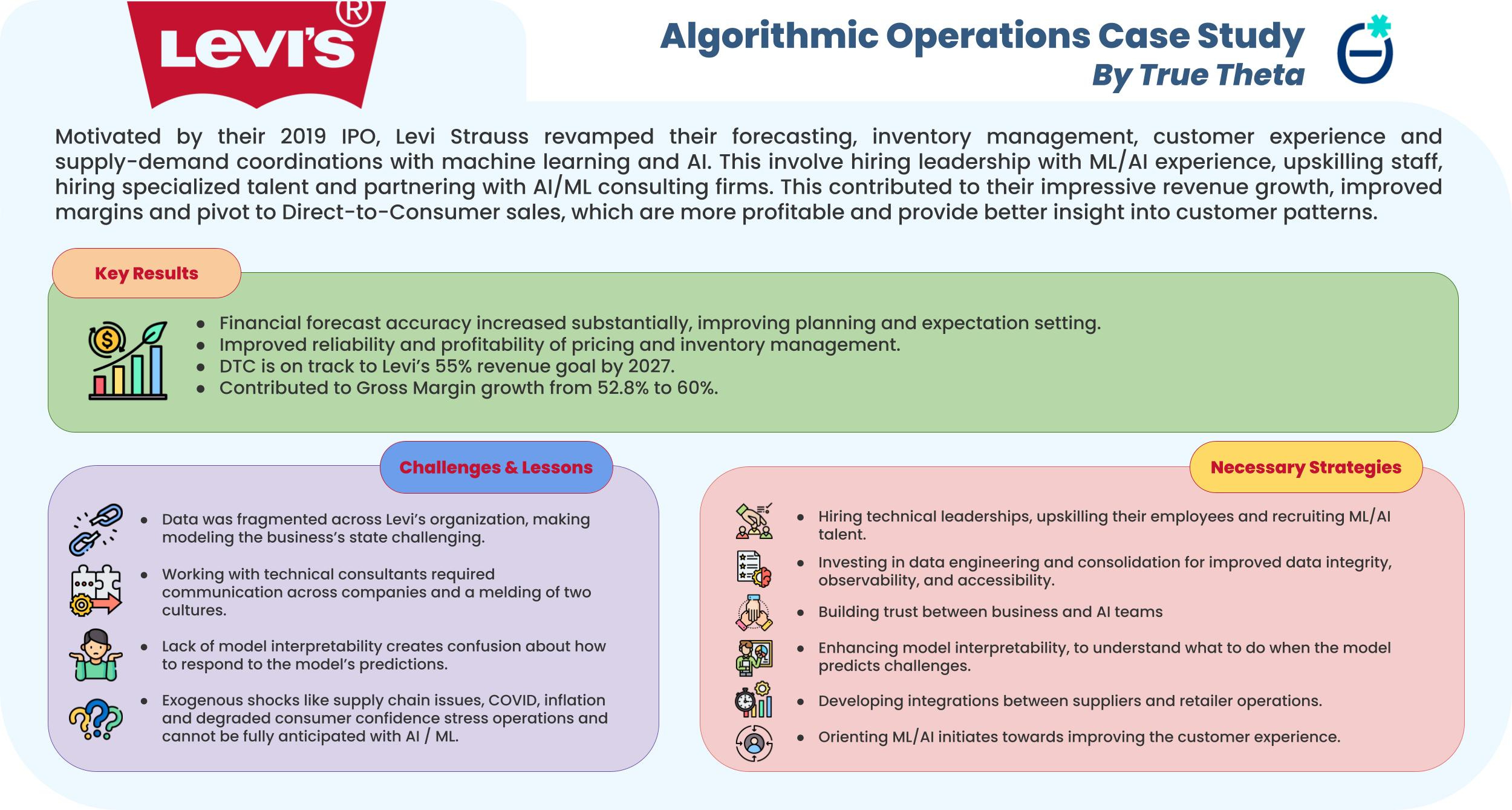
Refer to the results infographic for a visual summary of these impressive outcomes:
Forecast accuracy significantly improved, enhancing planning and profitability.
Gross margins increased notably from 52.8% to 60%.
DTC channel grew substantially, nearing the ambitious 55% revenue goal for 2027.
Inspired by Levi’s wins? Let us know which industry you’d like us to tackle next!
Challenges & Lessons Learned
Data fragmentation across business units presented initial obstacles.
Integrating consultants required extensive cross-company communication and cultural alignment.
Interpretability of AI models was crucial for effective human-AI collaboration.
AI alone cannot fully anticipate external shocks like COVID, inflation, and supply chain disruptions; human oversight remains critical.
Essential Strategies
Invest in data consolidation and robust infrastructure.
Upskill employees and recruit specialized AI talent.
Foster trust and collaboration between business and technical teams.
Prioritize interpretability and practical usability of AI models.
The accompanying visuals provide a clear roadmap and detailed summary, serving as practical tools for advocating AI-driven transformation within your organization.
Stick with us as we uncover more AI success stories, and let us know which industry you'd like us to feature next.